
Every summer we get the same call, usually a day or two after a storm wall rolls through the Valley. The car is coated in a fine brown film, the owner ran it through a tunnel wash or wiped it down with a towel, and now the paint looks hazier than it did before they cleaned it.
That haze isn't bad luck. It's the predictable result of how Arizona dust behaves against automotive clear coat, and it's one of the most common kinds of damage we see on Valley vehicles.
Monsoon dust is not ordinary dirt
What rolls across the Phoenix metro during a haboob is largely fine mineral particulate — silica and quartz-family grit lifted off the desert floor. On the Mohs hardness scale, quartz sits around 7. Automotive clear coat sits far below that. In plain terms, the dust on your hood is meaningfully harder than the surface it's sitting on.
That single fact explains almost everything about monsoon paint damage. Dirt that is softer than clear coat gets pushed around. Dirt that is harder than clear coat cuts into it.
Why the car looks worse after you clean it
When that grit gets dragged across the surface — by a dry microfiber, a gas-station squeegee, a brush-style tunnel wash, or a wash mitt that skipped the rinse step — each particle carves a shallow trench. Individually they're invisible. By the thousand, they scatter light in every direction instead of reflecting it cleanly back at you.
That scatter is what people describe as the paint looking dull, cloudy, or "tired." It reads worst on dark colors in direct sun, which is why black and dark-grey vehicles in the Valley seem to age so much faster than silver ones. The damage is identical; darker paint just shows it.
The part that compounds
Monsoon season doesn't deliver one event. It delivers dust, then rain, then more dust, over and over from roughly June through September. Each cycle deposits a fresh abrasive layer, and every dry wipe between storms adds another round of micro-scratching to paint that hasn't recovered from the last one.
Add roughly 300 days of sun a year — which is breaking down the clear coat's UV defenses at the same time — and you get the specific look of a neglected Phoenix car: flat, slightly chalky, with swirl patterns that catch the light in the parking lot.
What actually works
Never touch a dry, dusty car
This is the single highest-return habit in Arizona car care, and it costs nothing. If the surface is dusty, it gets rinsed or foamed before anything makes contact with it. No exceptions for "just a quick wipe of the windshield."
Lift before you touch
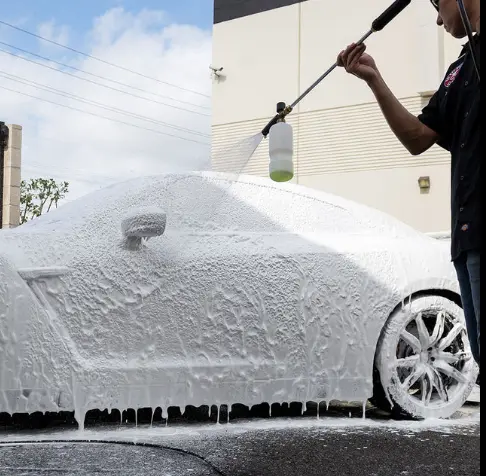
A proper wash sequence on a monsoon-coated vehicle is a pressurized rinse, then a foam layer left to dwell so it can encapsulate and float the grit off the surface, then contact washing with clean media and frequent rinsing. The goal of everything before the mitt is to remove as much abrasive as possible while it's still suspended in water rather than trapped against paint.
Give the grit somewhere else to sit
A ceramic coating doesn't make paint scratch-proof, and anyone who tells you it does is selling something. What it does is add a harder, slicker sacrificial layer above the clear coat, so dust releases more easily during a rinse and there's a buffer between the abrasive and the finish you actually care about. On a Valley vehicle that lives outside, that buffer earns its keep fast.
Deal with what's already there
Washing correctly stops new damage. It doesn't remove old damage. Scratches already cut into the clear coat come out through paint correction — machine polishing that levels the surface back to flat so it reflects cleanly again. That's a restoration step, and it's worth doing before a coating goes on, so you're protecting a corrected finish rather than sealing in swirls.
A realistic monsoon routine
- After a storm: rinse the car within a few days, before the next round bonds down. Don't let dust sit through a rain cycle if you can help it.
- Through the season: maintenance washing every two to three weeks, done correctly, beats a deep clean twice a summer.
- Before summer: correction and protection, in that order, so the finish goes into monsoon season with a real defense on it.
- Never: brush tunnels, dry wiping, or a bath towel from the linen closet.
None of this is exotic. It's just specific to living here. A car in a mild coastal climate can survive a lot of casual maintenance. A car parked in the Phoenix metro is in a more demanding environment than most owners realize, and the paint keeps a running record of how it's been treated.
Monsoon season leave a mark?
We'll come to your driveway anywhere in the Valley, decontaminate the paint properly, and tell you plainly whether it needs correction or just a good reset.
Book Online