
Here's a pattern we see constantly across Scottsdale, from Old Town condos to DC Ranch driveways: a genuinely nice car that looks flawless in the garage and noticeably tired the moment it rolls into direct sun.
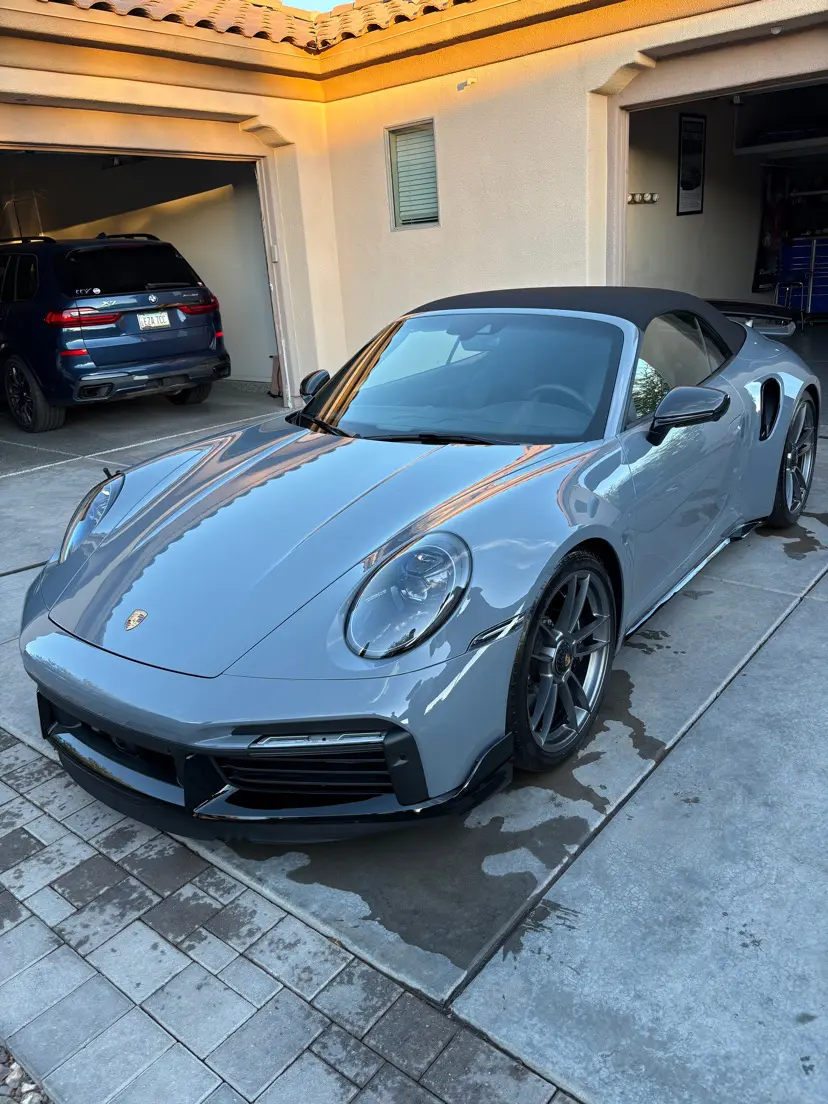
That gap between how a car looks indoors and how it looks outdoors has one overwhelmingly common cause, and it isn't dirt.
What swirl marks actually are
Swirl marks are thousands of very fine scratches in the clear coat, most of them shallower than a human hair is wide. Individually, none of them is visible. Collectively, they change how the surface handles light.
Undamaged clear coat is optically flat, so it reflects light back at you coherently — that's the mirror-like depth people mean by "wet look." A swirled surface is covered in microscopic trenches, each catching light at its own angle and throwing it in a different direction. Instead of one clean reflection you get diffuse scatter, which reads to the eye as haze, dullness, or a faint cobweb pattern spiraling out from a bright point.
This is also why the damage seems to appear and disappear. Under a garage's soft overhead light, scatter is invisible. Under direct desert sun — a single intense point source — every trench lights up at once.
Where they come from
Essentially all swirl marks come from something touching the paint. The usual sources, roughly in order of how much damage they do:
- Automatic brush washes. Spinning bristles carry grit from every car ahead of you in line. A single pass can undo a professional correction.
- Dry wiping. Removing Valley dust with a dry towel drags hard mineral particulate across the surface. Monsoon dust is harder than clear coat, which is what makes this so destructive.
- One-bucket washing. Rinsing a dirty mitt into the same water you keep dipping into just reapplies the grit you removed.
- Dirty or low-quality drying towels. The final step is where a surprising amount of damage happens.
- Well-meaning quick detailer use. Spraying and wiping a dusty panel is the same abrasive problem in a bottle.
Dark colors don't get swirled more easily — they simply show it. Black, dark grey, and deep blue vehicles display scatter dramatically, while silver and white hide the identical damage. Given how many dark vehicles are parked around Scottsdale, we see a lot of it.
What paint correction actually does
Correction is the removal of a microscopically thin layer of clear coat — using a machine polisher, a pad, and an abrasive compound — until the surface is level with the bottom of the scratches. You aren't filling anything in. You're bringing the surface down to flat so it reflects coherently again.
This matters, because filler-based products do exist: glazes and some all-in-one products temporarily mask swirls with oils that wash out within weeks. The car looks corrected until it isn't. Real correction changes the surface itself, and the result doesn't wash away.
Why it's measured in stages
A single-stage correction uses one compounding and polishing step and removes the majority of moderate swirling — the right call for most daily drivers. A multi-stage correction adds a heavier cutting step for deeper defects followed by progressively finer polishing to refine the finish. More stages means more defect removal, more time, and more clear coat consumed.
The limit nobody mentions
Clear coat is finite. Every correction removes some, and it doesn't grow back. A responsible detailer measures thickness, works conservatively, and will tell you when a defect is too deep to chase safely. Removing a scratch is never worth risking a burn-through — that turns a cosmetic problem into a repaint.
This is the main reason we push back gently when someone asks for perfection on a ten-year-old daily driver. Getting it to look genuinely excellent is usually the better trade than getting it to look flawless once.
Correct first, then protect
Correction restores the finish. It doesn't keep it that way. A corrected car washed the same way it was washed before will be swirled again within a season.
That's why correction and protection belong together: level the paint, then lock in the result with a ceramic coating that adds a harder layer above the clear coat and makes future washing far less abrasive. We covered the reasoning in ceramic coating versus wax in Arizona heat.
Pair it with a wash routine that never touches dry paint and never sees a brush tunnel, and the correction holds for years instead of months.
How to check your own car
Pull into direct sun, stand so the sun reflects off a horizontal panel toward your eyes, and look at the reflection rather than the paint. Sharp, deep, mirror-like reflection means the clear coat is flat. A fine web or halo of light spinning out from the bright spot means swirls.
If you see the web, the good news is that it's clear coat damage, not color damage — which means it's almost always correctable. We bring the full correction setup to you, anywhere in Scottsdale and across the greater Phoenix area, so the car never leaves your driveway.
See the web in your reflection?
We'll come to your Scottsdale driveway, assess the paint in person, and tell you exactly what a correction would and wouldn't fix on your vehicle.
Book Online